You can go here to see the list.
I always like book lists. Just more to add to my to-read pile! I'm slowly starting to get more into sci-fi so this seems like a good list to start from. Interestingly enough, I went to a talk by Charlie Jean Anders at Butler University recently. More on that to come......
Wednesday, April 12, 2017

Sunday, April 9, 2017
Dragonfly in Amber by Diana Gabaldon
I had finished reading Outlander back in December 2015 and, as much as I adored it, never got around to continuing the series. I watched the first season of the show (SWOON) and let season 2 pile up while I tackled Dragonfly in Amber. These are TOMES. I could hurl this book at a person's head and quite possibly knock them out cold. Dragonfly clocks in at about 740 pages.
I ended up putting the actual book away and grabbed the audiobook, read by Davina Porter (fantastically read by, I might add), because I went a little crazy at the local library and checked out too many books. At least listening to Dragonfly kept me moving right along. I started reading this in February 2017 and, quite literally, just finished the book. I was thisclose to tearing into Voyager, the next book in the series, but stopped myself so I can finish my last library book. My goodness this is a fantastic series. To catch you up, here is my review of the first in the series, Outlander.
Dragonfly in Amber starts in a very unexpected way: Claire is back in her century, showing up on Roger Wakefield's doorstep in Invermess, in 1968. Roger, remember, was the little boy that Reverend Wakefield had adopted, whom we met in Outlander. Roger is quite grown up now and Claire arrives with her daughter, Brianna, a vibrant 20 year old red head. Start doing the math here, folks. Claire asks Roger to help research the fates of the clansman who fought at Culloden. In 1745, the Jacobites fight, and lose terribly, at Culloden, to try and put Charles Stuart back on the throne. It's a terrible battle that nearly wipes out the Scots and Claire wants closure, it seems, on the people that she knew and spent so many years with in 18th-century Scotland.
While researching, Roger, Brianna, and Claire seek out a cemetery and come across James Fraser's gravestone marked as the "Beloved Husband of Claire". That sparks the telling of her adventures to Brianna and Roger, including the telling of Brianna's true father, Jamie.
Part II takes us immediately to 1744, France, and Claire vomiting from morning sickness. Jamie and Claire are in "high society" France to do what they can to stop Charles Stuart from waging his war to gain the throne, using the Scots as pawns in his battle. A great deal happens on so many levels in Paris that I can't recount them all and, frankly, I wouldn't want to. This is a great story told by a great writer and it's worth the travel with Claire and Jamie.
We do end up back in Scotland, with many deaths, many upsets and many nail-biting moments. Claire, as we already know, ends up going back through the stones into her century and giving birth to Jamie's daughter, Brianna. The last bit of the book turned out to be more of a twisted path and left us with a shocking bit of revelation.
The audio book is approximately 38 hours long and the last, oh, 10 hours or so I devoured in 3 days. I really wished that I didn't have to sleep at that point...or work... but alas.
I highly recommend this series. It's daunting in size, but so very worth the time.
Friday, April 7, 2017
Choose my next book!
Or rather... choose my classic tome of 2017!
Click to vote!
Voting is for one more week and you are choosing between:
War and Peace by Leo Tolstoy
Tolstoy's epic masterpiece intertwines the lives of private and public individuals during the time of the Napoleonic wars and the French invasion of Russia. The fortunes of the Rostovs and the Bolkonskys, of Pierre, Natasha, and Andrei, are intimately connected with the national history that is played out in parallel with their lives. Balls and soirees alternate with councils of war and the machinations of statesmen and generals, scenes of violent battles with everyday human passions in a work whose extraordinary imaginative power has never been surpassed.
The prodigious cast of characters, seem to act and move as if connected by threads of destiny as the novel relentlessly questions ideas of free will, fate, and providence. Yet Tolstoy's portrayal of marital relations and scenes of domesticity is as truthful and poignant as the grand themes that underlie them.
Roots by Alex Haley
When he was a boy in Henning, Tennessee, Alex Haley's grandmother used to tell him stories about their family—stories that went back to her grandparents, and their grandparents, down through the generations all the way to a man she called "the African." She said he had lived across the ocean near what he called the "Kamby Bolongo" and had been out in the forest one day chopping wood to make a drum when he was set upon by four men, beaten, chained and dragged aboard a slave ship bound for Colonial America.
Still vividly remembering the stories after he grew up and became a writer, Haley began to search for documentation that might authenticate the narrative. It took ten years and a half a million miles of travel across three continents to find it, but finally, in an astonishing feat of genealogical detective work, he discovered not only the name of "the African"--Kunta Kinte—but the precise location of Juffure, the very village in The Gambia, West Africa, from which he was abducted in 1767 at the age of sixteen and taken on the Lord Ligonier to Maryland and sold to a Virginia planter.
Haley has talked in Juffure with his own African sixth cousins. On September 29, 1967, he stood on the dock in Annapolis where his great-great-great-great-grandfather was taken ashore on September 29, 1767. Now he has written the monumental two-century drama of Kunta Kinte and the six generations who came after him—slaves and freedmen, farmers and blacksmiths, lumber mill workers and Pullman porters, lawyers and architects—and one author.
But Haley has done more than recapture the history of his own family. As the first black American writer to trace his origins back to their roots, he has told the story of 25,000,000 Americans of African descent. He has rediscovered for an entire people a rich cultural heritage that slavery took away from them, along with their names and their identities. But Roots speaks, finally, not just to blacks, or to whites, but to all people and all races everywhere, for the story it tells is one of the most eloquent testimonials ever written to the indomitability of the human spirit.
Moby Dick by Herman Melville
'Call me Ishmael.'
So begins Herman Melville's masterpiece, one of the greatest works of imagination in literary history. As Ishmael is drawn into Captain Ahab's obsessive quest to slay the white whale Moby-Dick, he finds himself engaged in a metaphysical struggle between good and evil. More than just a novel of adventure, more than an paean to whaling lore and legend, Moby-Dick is a haunting social commentary, populated by some of the most enduring characters in literature; the crew of the Pequod, from stern, Quaker First Mate Starbuck, to the tattooed Polynesian harpooner Queequeg, are a vision of the world in microcosm, the pinnacle of Melville's lifelong meditation on America. Written with wonderfully redemptive humour, Moby-Dick is a profound, poetic inquiry into character, faith, and the nature of perception.
Herman Melville is now regarded as one of America's greatest novelists. Much of the material for his novels was drawn from his own experience as a seaman aboard whaling ships. He wrote his masterpiece Moby-Dick in 1851, and died in 1891.
Les Miserables by Victor Hugo
Introducing one of the most famous characters in literature, Jean Valjean—the noble peasant imprisoned for stealing a loaf of bread—Les Misérables ranks among the greatest novels of all time. In it, Victor Hugo takes readers deep into the Parisian underworld, immerses them in a battle between good and evil, and carries them to the barricades during the uprising of 1832 with a breathtaking realism that is unsurpassed in modern prose. Within his dramatic story are themes that capture the intellect and the emotions: crime and punishment, the relentless persecution of Valjean by Inspector Javert, the desperation of the prostitute Fantine, the amorality of the rogue Thénardier, and the universal desire to escape the prisons of our own minds. Les Misérables gave Victor Hugo a canvas upon which he portrayed his criticism of the French political and judicial systems, but the portrait that resulted is larger than life, epic in scope—an extravagant spectacle that dazzles the senses even as it touches the heart.
Click to vote!
Voting is for one more week and you are choosing between:
War and Peace by Leo Tolstoy
Tolstoy's epic masterpiece intertwines the lives of private and public individuals during the time of the Napoleonic wars and the French invasion of Russia. The fortunes of the Rostovs and the Bolkonskys, of Pierre, Natasha, and Andrei, are intimately connected with the national history that is played out in parallel with their lives. Balls and soirees alternate with councils of war and the machinations of statesmen and generals, scenes of violent battles with everyday human passions in a work whose extraordinary imaginative power has never been surpassed.
The prodigious cast of characters, seem to act and move as if connected by threads of destiny as the novel relentlessly questions ideas of free will, fate, and providence. Yet Tolstoy's portrayal of marital relations and scenes of domesticity is as truthful and poignant as the grand themes that underlie them.
When he was a boy in Henning, Tennessee, Alex Haley's grandmother used to tell him stories about their family—stories that went back to her grandparents, and their grandparents, down through the generations all the way to a man she called "the African." She said he had lived across the ocean near what he called the "Kamby Bolongo" and had been out in the forest one day chopping wood to make a drum when he was set upon by four men, beaten, chained and dragged aboard a slave ship bound for Colonial America.
Still vividly remembering the stories after he grew up and became a writer, Haley began to search for documentation that might authenticate the narrative. It took ten years and a half a million miles of travel across three continents to find it, but finally, in an astonishing feat of genealogical detective work, he discovered not only the name of "the African"--Kunta Kinte—but the precise location of Juffure, the very village in The Gambia, West Africa, from which he was abducted in 1767 at the age of sixteen and taken on the Lord Ligonier to Maryland and sold to a Virginia planter.
Haley has talked in Juffure with his own African sixth cousins. On September 29, 1967, he stood on the dock in Annapolis where his great-great-great-great-grandfather was taken ashore on September 29, 1767. Now he has written the monumental two-century drama of Kunta Kinte and the six generations who came after him—slaves and freedmen, farmers and blacksmiths, lumber mill workers and Pullman porters, lawyers and architects—and one author.
But Haley has done more than recapture the history of his own family. As the first black American writer to trace his origins back to their roots, he has told the story of 25,000,000 Americans of African descent. He has rediscovered for an entire people a rich cultural heritage that slavery took away from them, along with their names and their identities. But Roots speaks, finally, not just to blacks, or to whites, but to all people and all races everywhere, for the story it tells is one of the most eloquent testimonials ever written to the indomitability of the human spirit.
Moby Dick by Herman Melville
'Call me Ishmael.'
So begins Herman Melville's masterpiece, one of the greatest works of imagination in literary history. As Ishmael is drawn into Captain Ahab's obsessive quest to slay the white whale Moby-Dick, he finds himself engaged in a metaphysical struggle between good and evil. More than just a novel of adventure, more than an paean to whaling lore and legend, Moby-Dick is a haunting social commentary, populated by some of the most enduring characters in literature; the crew of the Pequod, from stern, Quaker First Mate Starbuck, to the tattooed Polynesian harpooner Queequeg, are a vision of the world in microcosm, the pinnacle of Melville's lifelong meditation on America. Written with wonderfully redemptive humour, Moby-Dick is a profound, poetic inquiry into character, faith, and the nature of perception.
Herman Melville is now regarded as one of America's greatest novelists. Much of the material for his novels was drawn from his own experience as a seaman aboard whaling ships. He wrote his masterpiece Moby-Dick in 1851, and died in 1891.
Les Miserables by Victor Hugo
Introducing one of the most famous characters in literature, Jean Valjean—the noble peasant imprisoned for stealing a loaf of bread—Les Misérables ranks among the greatest novels of all time. In it, Victor Hugo takes readers deep into the Parisian underworld, immerses them in a battle between good and evil, and carries them to the barricades during the uprising of 1832 with a breathtaking realism that is unsurpassed in modern prose. Within his dramatic story are themes that capture the intellect and the emotions: crime and punishment, the relentless persecution of Valjean by Inspector Javert, the desperation of the prostitute Fantine, the amorality of the rogue Thénardier, and the universal desire to escape the prisons of our own minds. Les Misérables gave Victor Hugo a canvas upon which he portrayed his criticism of the French political and judicial systems, but the portrait that resulted is larger than life, epic in scope—an extravagant spectacle that dazzles the senses even as it touches the heart.
Vote! Vote! Vote!
I want to read all of them but can only tackle one this year. Help me decide!
I want to read all of them but can only tackle one this year. Help me decide!
Saturday, April 1, 2017
The Collapsing Empire by John Scalzi
I've heard of Scalzi, but I've never read anything by him. I assumed that, since I never cared for sci-fi growing up, I'm not going to ever enjoy sci-fi. Something neat must happen as you age because I enjoyed the HELL out of this book. What else have I missed? Who else do I need to start reading? I feel like I've lost a lot of time here!
I only meant to go renew my library card. My library is so smart, they place the new arrivals right as you walk in the door. You can't get to the front desk without seeing all those new, fresh, ready-to-be-read books. Scalzi was right up there and I thought "I've heard good things, maybe I should give it a try." So he went home with me,
I need to work on wrapping my head around sci-fi concepts of interplanetary living and space travel. But Scalzi's writing is so fantastic I didn't even care if some of the "light travel" concepts confused me. The Collapsing Empire is the first book in a new series (yay! now I get to wait for book 2!). Reading sci-fi is like working out, I think, the more I do it, the better I'll be at it. That's my theory anyways.
The Flow is an extradimensional field that people use to travel from planet to planet. You can't travel faster than light (physics!) so The Flow is necessary to trade at distant planets. The Earth is gone and new planets are inhabited by humans. It's good to know that ruling class still stands and humans are still out to make the most money and rule over the poorer people. Hub is the beginning and end of many of the Flow streams, hence...Hub, and the ruling house of Wu is the richest house while also being the Emperox of the entire planetary system. Several other houses, Lagos and Nohamapetan, want Wu's spot and they are willing to do whatever they need to in order to get it.
The Flow is disappearing. A Flow physicist who lives on End has been researching this for years, paid for by the previous Emperox. If the Flow to a planet disappears, that planet ceases to exist. The people of the planet are left on their own to die out over several years. Depressing, yes? The House of Nohamapetan gets similar information, except they are told the Flow streams are shifting and everything will move away from Hub and shift to End. Underhanded people that they are, they have a plan to rule End so when the shift happens, they will be the top dog.
Nothing goes to plan and it's entertaining to watch. I do adore that Lady Kiva from House Lagos swears like a sailor with Tourette's Syndrome. She's seriously my kind of girl. I'm very ready for the next book to see where we go and I'm going to have to check out more of Scalzi's work. I'm in love!
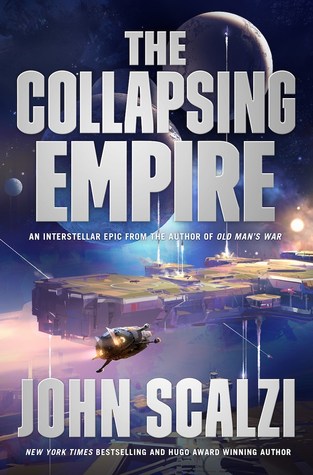
I only meant to go renew my library card. My library is so smart, they place the new arrivals right as you walk in the door. You can't get to the front desk without seeing all those new, fresh, ready-to-be-read books. Scalzi was right up there and I thought "I've heard good things, maybe I should give it a try." So he went home with me,
I need to work on wrapping my head around sci-fi concepts of interplanetary living and space travel. But Scalzi's writing is so fantastic I didn't even care if some of the "light travel" concepts confused me. The Collapsing Empire is the first book in a new series (yay! now I get to wait for book 2!). Reading sci-fi is like working out, I think, the more I do it, the better I'll be at it. That's my theory anyways.
The Flow is an extradimensional field that people use to travel from planet to planet. You can't travel faster than light (physics!) so The Flow is necessary to trade at distant planets. The Earth is gone and new planets are inhabited by humans. It's good to know that ruling class still stands and humans are still out to make the most money and rule over the poorer people. Hub is the beginning and end of many of the Flow streams, hence...Hub, and the ruling house of Wu is the richest house while also being the Emperox of the entire planetary system. Several other houses, Lagos and Nohamapetan, want Wu's spot and they are willing to do whatever they need to in order to get it.
The Flow is disappearing. A Flow physicist who lives on End has been researching this for years, paid for by the previous Emperox. If the Flow to a planet disappears, that planet ceases to exist. The people of the planet are left on their own to die out over several years. Depressing, yes? The House of Nohamapetan gets similar information, except they are told the Flow streams are shifting and everything will move away from Hub and shift to End. Underhanded people that they are, they have a plan to rule End so when the shift happens, they will be the top dog.
Nothing goes to plan and it's entertaining to watch. I do adore that Lady Kiva from House Lagos swears like a sailor with Tourette's Syndrome. She's seriously my kind of girl. I'm very ready for the next book to see where we go and I'm going to have to check out more of Scalzi's work. I'm in love!
Sunday, March 12, 2017
Norse Mythology by Neil Gaiman
I'm biased, I know, because I feel like Gaiman can do no wrong. I will read all of his books even if I'm a bit skeptical of the premise, such as Norse mythology. Not really my thing, but it's Neil Gaiman.
I have a new appreciation for Norse Mythology! Although, admittedly, I kept picturing Thor and Loki as Chris Hemsworth and Tom Hiddleston but, hey, movies ruin everything. Gaiman crafted the myths of gods with such an approach that made it less myth and more novel (captivating novel, no less).
He walks us through the players first: Odin, Thor and Loki. Then he guides us through all the pertinent stories that shape the myths from the Beginning to the End. The end leaves us with slaughter of the gods with Ragnarok. The story of Kvasir is actually the one that stuck with me the most. His blood, taken in a most brutal way, became the mead of poetry.
I appreciate short stories quite a bit as they take more thought and craft than long novels, I think. To be able to tell a story and engage the reader in just a few pages takes skill and Neil Gaiman has skill in abundance.
Even if you think Norse myths are not your thing, take a chance with this. Despite the unpronounceable names (how do you pronounce names that are almost all consonants???).... maybe listen to the audio :)
Top 10 Coolest Creatures from Norse Mythology
Sunday, March 5, 2017
Lincoln in the Bardo by George Saunders
I'm declaring this the best audio book of the year!!! I can't imagine how the written form looks because the audio was almost play-like with citations of sources all over the place. This really was a brilliant way to portray the death of Willie Lincoln and the grief of his father.
The bardo is the Buddhist concept of the space between life and moving on. The mid-life? Almost like purgatory, but, as is with most Buddhist concepts, leaving the decisions up to the deceased. In the bardo, the dead are not being punished or cleansed. They are dealing with their regrets and, for the most part, not even acknowledging that they are dead, despite seeing their own corpses inside their coffins (sick-boxes) in the cemetery (hospital-yard).
When Willie dies of typhoid at age 11, his body is sheltered in a borrowed mausoleum. Willie's ghost comes out in the night and we get introduced to the ghosts that are still refusing to leave the cemetery. Vollman (voiced by Nick Offerman), a printer, died when a beam caved in his skull and before he could consummate his marriage. Bevins (voiced by David Sedaris), is a young, closeted gay man who commits suicide when his lover dumps him for another man. When he was at death's door, he realized he didn't want to die. Unfortunately, it was too late and he is stuck in the bardo with great regrets. Reverend Thomas (voiced by George Saunders) is a confusing ghost. He has a permanent terrified look on his face but does not have real reason for not moving on. Later in the book, we get his story.
Abraham Lincoln visits his son in the night and holds him in the crypt. The ghosts are mesmerized and astounded that someone actually had someone who loved them visit. Willie decides to not move on so he can continue seeing his dad. Unfortunately, as ghosts tarry in the bardo, they begin to unravel mentally. Children begin losing touch very quickly and really should move on as fast as they can.
The audio book and it's cast of voices is simply mesmerizing. The hospital-yard portions are read from the point of view of all the ghosts who have not yet left and oh, those stories are heartbreaking. The Barons provided comic relief until you really listen to what they were saying about their lives, instead of how they said it. The moments of Lincoln grieving his son were so well done and can easily squeeze a tear from your eye.
The other part of the book is the story of Lincoln and how Willie died as told by citations of sources (some real, some invented). It's a bit jarring at first to hear so many citations but very quickly it melded into a good story, amusing at times for the sources that disagreed with each other ("The moon was red.", "The moon was bright white.", "There was no moon that night") and for the only time the sources agreed ("Lincoln was the homeliest of men","He was the ugliest man I've seen.","A homelier man was never found"). Poor Lincoln.
Saunders starts with the concept of the bardo but adds in so many different elements, including afterlife and how ghosts can influence living people, that it ends up being a really great mish-mash of different concepts. And really, who can tell if this would even be remotely true? We don't know what will happen when we die. Either way, this was fun, well-told, heartbreaking and thought-provoking. Get the audio book for this and skip the printed version. It will be worth it.
The Princess Diarist by Carrie Fisher
This had been on my list before Fisher died so when I got the Audible credit, I went ahead and bought it. I've read several other of Fisher's books and they made me laugh. I was hoping this would do the same and give me a behind the scenes look at the making of Star Wars.
There were definite parts of this book that were very funny. Fisher herself read the book with her daughter Billie reading other parts. Overall, though, this book actually made me feel a bit uncomfortable.
Fisher talked a great deal about her affair with a then-married Harrison Ford. Granted, it's 40 years after it happened and Ford has re-married twice more since then, but I think it was the "Maybe he'll divorce her and marry ME!" commentary that bothered me. Fisher was only 19 during the filming of Star Wars so her young, naive way of dealing with an older man made sense. The diaries that Fisher based this book on basically only covered the affair and her desperate need to have Ford just love her and swoop her away to bliss. This topic covered about 2/3 of the book.
There was a bit of funny insight from the set as well as some disturbing insight. I'm not sure Fisher found it disturbing, at least she blew it off in the book, but the crew getting a 19 year old female actor drunk as hell and then trying to escort her away from the party to be alone with them....that reads as dangerous to me. Fisher didn't believe any harm would come to her, but again, she was naive. "Luckily", Ford rescued her from the crew with the admonishment that she clearly couldn't make a decision for herself, only to go after her himself in the backseat of a car. Hence my Luckily in quotes. Harrison.....she was too drunk to make a decision for herself.
I did have trouble listening to a lovestruck, starry-eyed 19 year old girl's poetry. That wasn't the fun part of this book.
I think I will recommend Carrie's other books ahead of this one, but a die hard fan will still want to read The Princess Diarist.
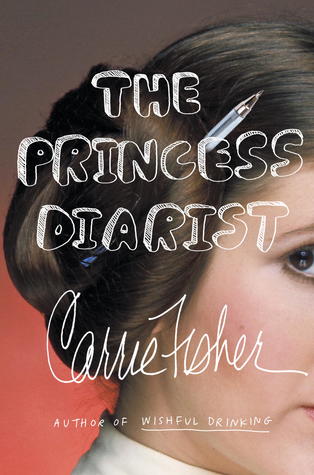
There were definite parts of this book that were very funny. Fisher herself read the book with her daughter Billie reading other parts. Overall, though, this book actually made me feel a bit uncomfortable.
Fisher talked a great deal about her affair with a then-married Harrison Ford. Granted, it's 40 years after it happened and Ford has re-married twice more since then, but I think it was the "Maybe he'll divorce her and marry ME!" commentary that bothered me. Fisher was only 19 during the filming of Star Wars so her young, naive way of dealing with an older man made sense. The diaries that Fisher based this book on basically only covered the affair and her desperate need to have Ford just love her and swoop her away to bliss. This topic covered about 2/3 of the book.
There was a bit of funny insight from the set as well as some disturbing insight. I'm not sure Fisher found it disturbing, at least she blew it off in the book, but the crew getting a 19 year old female actor drunk as hell and then trying to escort her away from the party to be alone with them....that reads as dangerous to me. Fisher didn't believe any harm would come to her, but again, she was naive. "Luckily", Ford rescued her from the crew with the admonishment that she clearly couldn't make a decision for herself, only to go after her himself in the backseat of a car. Hence my Luckily in quotes. Harrison.....she was too drunk to make a decision for herself.
I did have trouble listening to a lovestruck, starry-eyed 19 year old girl's poetry. That wasn't the fun part of this book.
I think I will recommend Carrie's other books ahead of this one, but a die hard fan will still want to read The Princess Diarist.
Subscribe to:
Posts (Atom)